


Mogadishu – The important contribution that Somali youth can make to their country’s future was highlighted today at a gathering of young people from civil society and representatives from the Somali government and the United Nations.
“When we talk about what Somalis want, what the people want, what the future holds, it's very much a conversation that involves the youth. You are the most significant demographic cohort in the country,” the UN Secretary-General’s Special Representative for Somalia, James Swan, told the gathering in the Somali capital.
“For the United Nations, in virtually all of our programming across the education sector, across the development sector, humanitarian response, there is always an emphasis and a concern on what this will mean for youth and how it will impact youth,” he added.
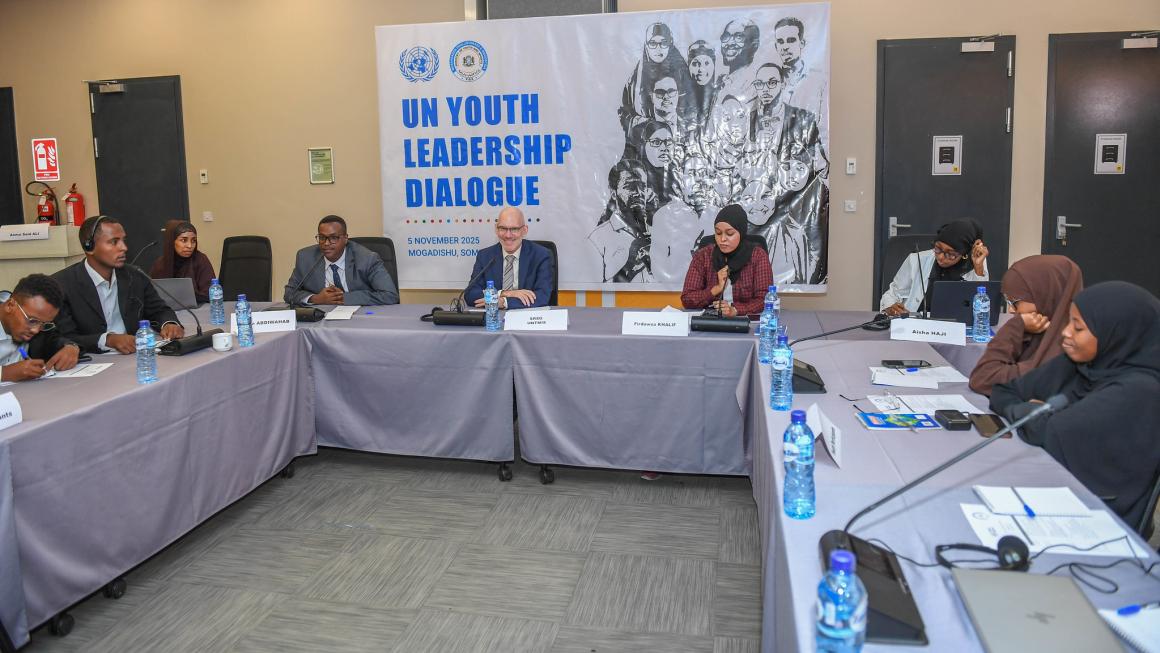
Held under the theme of ‘World Programme of Action for Youth at 30: Accelerating Global Progress Through Intergenerational Collaboration,’ today’s Youth Dialogue was organised by the Federal Ministry of Youth and Sports (MYS), with support from the United Nations in Somalia.
It brought together more than 40 young people from youth-related civil society groups, as well as representatives from the United Nations and Federal Government of Somalia. The latter included the Minister of Youth and Sports, Mohamed Abdulkadir Ali, and the MYS’ Director of Policy and Planning, Hamza Abdiwahab.
The first in a series, the event was aimed at facilitating direct dialogue between young people, the government and the UN system in Somalia in order to identify actions to strengthen youth engagement, in addition to exploring key issues that resonate with young people’s priorities and aspirations for Somalia.
Youth bulge
In a population of close to 20 million, nearly eight in every ten Somalis are under the age of 35. The UN system’s support for the country’s youth is wide-ranging, carried out through a comprehensive range of programmes and initiatives aimed at tackling key challenges such as unemployment, climate resilience, peacebuilding, and political participation, aligned with Somalia’s national priorities and the UN Youth Strategy.

Somalia’s achievements in the youth field include the adoption of a National Youth Policy for 2023–2030 which provides a comprehensive framework for youth development, focusing on inclusion, economic empowerment, and civic participation.
More recently, the Federal Government of Somalia has developed a National Action Plan for Youth, Peace and Security (YPS) which builds on the policy and recognizes the crucial role of young people in peacebuilding and development.
In his remarks, Minister Ali underlined the priority the government gives to Somali youth.

“To the youth of Somalia: You are the foundation of peace, progress, and prosperity. Your voices, dreams, and ideas will shape the Somalia we all envision – one that is united, strong, and full of promise,” he told the gathering.
“We are working to expand access to education, create employment opportunities, promote health and well-being, and strengthen youth participation in governance,” he continued. “Initiatives such as the youth employment skills programme, sports for peace activities, and entrepreneurship projects are empowering thousands of young Somalis to shape a brighter future.”
Following the opening of the Youth Dialogue, participants took part in a panel discussion before breaking down into smaller groups to explore strategies on fostering youth participation across Somalia.
Key outcomes from the dialogue will be presented to the Federal Ministry of Youth and Sports and United Nations for consideration on strengthening youth engagement by government, non-government organisations, and youth-led organisations.
Today’s event also marked the 30th anniversary of the World Programme of Action for Youth, a framework adopted by the UN General Assembly in 1995 to enhance the well-being and opportunities of youth in education, employment, health and governance.


